
UAE Thunderstorm March 2026: Full Impact Report & Safety Guide for Residents

If you woke up to flashing skies, flooded streets, or a cancelled flight this week — you’re not imagining it. The UAE is in the middle of one of the most intense storm systems it has seen in years. What started as a weather advisory quickly escalated into a nationwide alert, affecting Dubai, Abu Dhabi, Sharjah, and the northern emirates simultaneously.
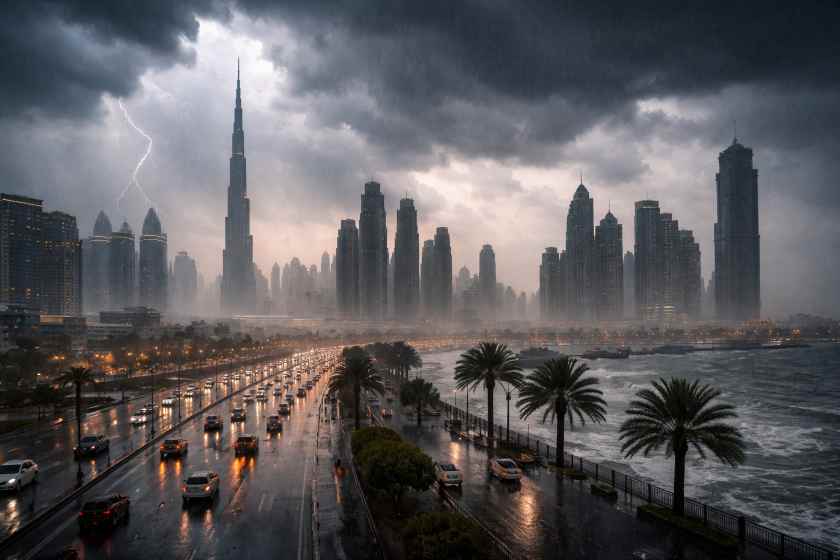
This isn’t your typical winter drizzle. The storm that intensified on March 27, 2026 is being described by meteorologists as a rare atmospheric event — powerful enough to strike the Burj Khalifa with lightning, flood major highways, and ground flights at one of the busiest aviation hubs in the world.
Here’s everything you need to know — what’s causing it, what it’s doing, and most importantly, what you should be doing right now.
What Kind of Storm Is This, Exactly?
Let’s clear something up first: this is not a cyclone. UAE authorities, including the National Center of Meteorology (NCM), have officially confirmed that no cyclone is approaching the country. If you’ve seen anything suggesting otherwise on social media, ignore it.
What the UAE is actually dealing with is a rare, complex low-pressure weather system driven by a specific combination of factors:
- An upper-level low-pressure trough originating over the Mediterranean
- Warm, moisture-heavy air rising from the Arabian Gulf
- Strong wind shear — a difference in wind speed and direction at different altitudes — creating the kind of atmospheric instability that fuels severe storms
The result? Rapid cloud development, explosive lightning activity, and rainfall totals that in some areas could equal the UAE’s entire annual average within a matter of days.
The storm system itself stretches roughly 1,400 km wide, covering much of the Middle East. That scale alone tells you this isn’t localized — it’s a regional event.
Why Is the Lightning So Unusual?
Residents across the UAE have reported something you don’t see here often: orange and purple lightning. It sounds dramatic, and scientifically, it is.
These unusual colors indicate two things happening at once:
- Dust interaction — suspended desert particles scatter light differently than clean air
- Extreme atmospheric instability — the kind that meteorologists associate with supercell thunderstorms, typically seen in the central United States, not the Arabian Peninsula
Wind speeds have been recorded at up to 74 km/h, and the electrical activity has been strong enough to visibly strike tall structures. This is what separates this event from a standard Gulf rainstorm.
Real-World Impact Across the UAE
Roads & Urban Flooding
Flash flooding hit multiple roads across Dubai and Abu Dhabi within hours of the heaviest rainfall. The core problem isn’t new — the UAE’s drainage infrastructure was built for a desert climate that historically sees minimal rainfall. When a storm dumps weeks’ worth of rain in hours, those systems simply can’t keep up.
Vehicles were stranded on major roads. Emergency services responded to dozens of incidents. In some outer areas, desert terrain was temporarily unrecognizable — sitting under several centimeters of water.
If you drive a low-clearance vehicle, this matters. Flooded roads that look shallow can be deceiving and dangerous.
Aviation Chaos
Dubai and Abu Dhabi airports both reported significant disruptions — delayed departures, incoming flight diversions, and outright cancellations. For a country whose economy depends heavily on being a global transit hub, this is particularly costly.
Emirates and Etihad were among the major carriers impacted. If you have travel planned in the next 48–72 hours, check your airline’s app before you leave the house. No journey is worth arriving at an airport during a lightning storm to find your flight cancelled.
Business Disruptions
Less visible but equally real — food delivery platforms paused operations in high-risk areas, retail footfall dropped sharply, and outdoor industries like construction came to a standstill. For SMEs in the hospitality and logistics sectors, a two-to-three day weather event like this can translate directly into revenue loss.
What About Neighboring Countries?
The UAE isn’t the only one dealing with the consequences. Oman has already reported fatalities linked to flooding from the same weather system. This context matters — it reminds us that what can feel like an inconvenience in a well-resourced city can be life-threatening in areas with different terrain and infrastructure.
Wadi flooding in particular is extremely dangerous. These dry riverbeds fill with violent water surges within minutes of rainfall upstream, catching people completely off guard.
Safety Guidelines You Should Actually Follow
This section isn’t filler. These are practical steps based on real risk scenarios this storm has already created.
If You’re at Home
- Stay indoors when lightning is active — not near windows, not on balconies
- Unplug non-essential electronics. Lightning surges can damage devices even through power strips
- Keep an emergency bag ready: water, torch, power bank, first aid kit, medication, important documents
If You Must Drive
- Never drive through flooded roads. Even 15–20 cm of moving water can push a car off course
- Avoid parking in underpasses, low-lying areas, or basement car parks
- Give yourself significantly more travel time and expect road closures
If You’re Near the Coast or Wadis
- Stay away from beaches until the NCM confirms conditions are safe
- Wadi areas are the most dangerous during and after rainfall — avoid them entirely
- Heed any local authority evacuation or warning notices immediately
For Families With Children
- Keep children indoors — schools may adjust schedules, verify before sending kids out
- Use this time to do a quick household check: torch batteries, water supply, phone charging
The Bigger Picture: Is This the New Normal?
Honestly? Climate scientists think it might be. Desert regions globally are experiencing more frequent and more intense weather anomalies — not because they’re “becoming wet,” but because shifting atmospheric patterns are pushing extreme systems into historically dry areas.
For the UAE specifically, this raises practical infrastructure questions:
- Can urban drainage systems be upgraded to handle high-intensity rainfall?
- Should building codes account more seriously for flooding risk?
- How does early-warning technology need to evolve for a region where residents rarely expect this type of weather?
These aren’t rhetorical questions. After 2024’s flooding event, UAE authorities had already begun reviewing infrastructure resilience. This storm reinforces that those efforts need to accelerate.
Where to Get Verified Information
This is critical. During any weather emergency, misinformation spreads faster than the storm itself.
Rely only on:
- NCM UAE — ncm.ae — the official source for weather alerts
- Dubai Media Office and Abu Dhabi Government official social channels
- Your airline’s official app or website for travel disruptions
Avoid sharing or acting on unverified WhatsApp forwards, anonymous social media posts, or any content that uses dramatic language without citing an official source.
What You Need to Do Right Now
The 2026 UAE thunderstorm is a serious, high-impact weather event — but it’s manageable if you respond sensibly. Here’s the short version:
- Don’t drive through flooded roads under any circumstances
- Avoid coastal and wadi areas until all-clear is given
- Check flights before travelling to any airport
- Follow NCM for real-time updates — not social media rumors
- Stay indoors during lightning activity
The storm will pass. The decisions you make while it’s happening are what matter.
Last updated: March 28, 2026. Always verify conditions with NCM before making travel or safety decisions.