
18 Cities in America That Feel Like Europe – Stunning US Destinations with Old-World Charm

18 Cities in America That Feel Like Europe offer travelers the charm of cobblestone streets, historic architecture, and rich cultural vibes—without crossing the Atlantic. From alpine-style villages to French-inspired quarters, these US destinations capture the romance, beauty, and atmosphere of Europe while giving you a unique American travel experience. Whether you’re planning your next vacation or just dreaming of Europe, these cities bring the old-world magic closer to home.
Which American Cities Feel Like Europe?
The American cities that feel most like Europe are New Orleans, Louisiana (French Quarter architecture, Creole culture), St. Augustine, Florida (Spanish Colonial, oldest US city founded 1565), Boston, Massachusetts (cobblestone streets, British colonial feel), Savannah, Georgia (Parisian squares and live oaks), Charleston, South Carolina (Georgian architecture, European café culture), Leavenworth, Washington (Bavarian Alpine village), Solvang, California (Danish windmills and culture), and Washington D.C. (French-designed grand boulevards). All 18 cities are listed and ranked below.
Why Do Some American Cities Feel Like Europe?
The United States is, at its core, a nation built by European immigrants — and many of them didn’t just bring their language and food when they arrived. They brought their architecture, their city planning philosophies, their religious traditions, and their deep cultural identity. In dozens of American cities and towns, that European DNA is not just visible — it’s the defining characteristic of the place.
Some of these cities feel European because of deliberate design choices: Washington D.C. was literally designed by a French architect. Others feel European because of genuine immigrant settlement: Frankenmuth, Michigan was founded as an explicitly Bavarian colony in the 1840s, and for decades residents spoke only German. Others feel European simply because they are genuinely old — St. Augustine, Florida was founded by the Spanish in 1565, predating the Mayflower by 55 years.
What they all share is a quality that’s hard to define but instantly recognisable: the sense, walking down a street, that you could be somewhere across the Atlantic.
This guide covers 18 American cities and towns that deliver that feeling most powerfully — ranked by authenticity, visual impact, and how complete the European illusion is. No passport required.
Why Visit Cities in America That Feel Like Europe?
1. New Orleans, Louisiana — France Meets the American South
Feels like: Paris + Seville | Best for: Food, architecture, nightlife, music
New Orleans is the most European major city in America — and it earns that title through both architecture and culture rather than just aesthetics. The French Quarter (Vieux Carré — “Old Square”) is a labyrinth of cast-iron balconies, open courtyard fountains, narrow cobblestone lanes, and Creole townhouses that are in an architectural league of their own on the American continent.
The French Quarter’s buildings are actually a blend of French and Spanish influence — rebuilt after the great fire of 1788 under Spanish rule, which is why the ironwork is Spanish in style while the street plan and culture remain deeply French. Either way, the effect is unmistakably European.
But New Orleans goes far beyond aesthetics. The city’s entire identity is built on French and Spanish foundations: the cuisine (beignets, croissants, po’boys on French bread), the street names (Bourbon, Toulouse, Chartres, Burgundy), the Catholic religious calendar (Mardi Gras, All Saints Day, Christmas processions), and the social habits — this is the only major American city where it is entirely legal to drink alcoholic beverages on the street, a custom ubiquitous across continental Europe.
Most European moment: Sipping café au lait and beignets at Café Du Monde at dawn, with the sound of a jazz trumpet drifting across Jackson Square, as the Cathedral-Basilica of St. Louis towers above — it is an experience that genuinely belongs to no other place on earth, but feels more French than most things you’ll find in modern France.
Don’t miss: Old Ursuline Convent (last intact example of colonial French architecture in the South), St. Louis Cathedral, Elysian Fields Avenue, Mardi Gras (February/March), Bastille Day celebrations (July)
Feels most like: Paris for the food and culture; Seville for the architectural ironwork and courtyard gardens
2. St. Augustine, Florida — Spain in the Sunshine State
Feels like: Málaga + Seville | Best for: History, Spanish architecture, cobblestone walks
If you want to experience Spain in its full glory without actually going to Spain, then your ideal destination is St. Augustine in Florida.
St. Augustine is not just old by American standards — it is genuinely, historically old. Founded by Spanish admiral Pedro Menéndez de Avilés on September 8, 1565, it is the oldest continuously occupied European settlement in the United States, predating the British colonies by generations. Walking its historic district is not a recreation of Spain — it is Spain, preserved by accident and geography for over four centuries.
The Castillo de San Marcos, built from coquina shell-stone between 1672 and 1695, is among the oldest surviving stone forts in North America and looks transplanted directly from the Iberian Peninsula. The narrow lanes of the historic district, the wrought-iron gates, the Mission Nombre de Dios, and the Cathedral Basilica of St. Augustine all reinforce the sense of a living Spanish colonial city.
Most European moment: Standing at the Castillo de San Marcos at sunset, the ancient coquina walls glowing amber against the Matanzas River — it is easy to forget you are in Florida.
Don’t miss: Castillo de San Marcos National Monument, St. George Street (pedestrian colonial shopping street), Mission Nombre de Dios, the Spanish Military Hospital Museum, Flagler College (built in the Spanish Renaissance style)
Feels most like: Málaga meets Seville — Spanish colonial architecture with a warm coastal setting
3. Boston, Massachusetts — America’s Most British City
Feels like: London + Dublin | Best for: History, walking, pubs, architecture
Founded in 1630, Boston is one of America’s oldest cities and the one that most consistently evokes the feeling of a British or Irish city. Beacon Hill — the neighbourhood that has remained largely unchanged since the Revolutionary War — is a collection of brick row houses, gas lamp posts, narrow cobblestone streets, and wrought-iron boot scrapers that could be lifted from Chelsea or Bloomsbury in London and placed down without anyone noticing.
Beyond Beacon Hill, Boston’s European qualities permeate the city: the Freedom Trail winds through colonial-era buildings and revolutionary sites that mirror the historic city centres of British and Irish cities; the North End’s dense Italian-American neighbourhood feels like a pocket of Naples; and the Boston Common is unmistakably modelled on London’s great urban parks.
Boston also shares a European relationship with its city: it is walkable in a way that almost no other American city is, with a culture of neighbourhood life — local pubs, corner cafes, independent bookshops, and farmers’ markets — that is far more reminiscent of London or Dublin than of any other American metropolis.
Most European moment: Walking across the cobblestones of Acorn Street on Beacon Hill at dusk, gas lamps flickering, brick townhouses closing in on either side — it is the most photographed street in America and one of the most authentically European-feeling scenes on the continent.
Don’t miss: Beacon Hill (especially Acorn Street and Louisburg Square), North End (Boston’s Little Italy, best cannoli in America at Mike’s Pastry), Quincy Market, Harvard Square in Cambridge, the Isabella Stewart Gardner Museum (modelled on a 15th-century Venetian palazzo)
Feels most like: London (Beacon Hill, the Common) + Dublin (the pub culture, the dense neighbourhood fabric) + a little of Rome in the North End
4. Savannah, Georgia — The Paris of the South
Feels like: Paris + Brussels | Best for: Architecture, history, café culture, romance
Savannah is possibly the most European-feeling city in the American South — a breathtaking grid of 22 public squares shaded by ancient live oaks draped in Spanish moss, surrounded by 18th and 19th century townhouses and mansions in Federal, Regency, and Gothic Revival styles that would be entirely at home in London or Brussels.
What makes Savannah feel European is not just the individual buildings but the deliberate planning philosophy behind the city: founder James Oglethorpe designed Savannah’s grid in 1733 specifically so that residents would always be within walking distance of a park, a church, a market, and a public gathering space — a planning philosophy identical to that of Barcelona and Haussmann’s Paris.
The result is a city where you can walk for hours, stopping at every square for shade and people-watching, dipping into independent cafes and art galleries, and never once feeling the need for a car. By American standards, that alone qualifies as a European miracle.
Most European moment: Sitting under the live oaks of Forsyth Park with a coffee as the morning light filters through the Spanish moss — the setting is as reminiscent of a Parisian park as anything you’ll find in the United States.
Don’t miss: Forsyth Park (Savannah’s version of the Tuileries), River Street, Savannah College of Art & Design’s galleries (free, multiple locations), Bonaventure Cemetery (one of the most beautiful in the world), the Historic District walking tour
Feels most like: Paris for the deliberate, walkable urban planning; Brussels for the 19th-century architecture and café culture
5. Charleston, South Carolina — Georgian Charm by the Sea
Feels like: Bath, England + Lisbon | Best for: Architecture, food, history, romance
Charleston has all the charm of a European vacation with the hospitality of the South. The city’s historic district is an extraordinarily intact collection of Georgian, Federal, and Antebellum architecture — pastel-painted row houses with iron-lace balconies, church steeples punctuating the skyline, and a cobblestone waterfront that feels lifted from the south coast of England or the older quarters of Lisbon.
Rainbow Row — a sequence of 13 Georgian row houses painted in candy pastels — is one of the most photographed streetscapes in America, and one of the most European-looking. The Battery, a promenade of antebellum mansions facing the harbour, recalls the Georgian seafront architecture of cities like Brighton, England.
Beyond the architecture, Charleston’s culture is European in temperament: the pace is slow and deliberate, the food is taken seriously (Charleston’s restaurant scene is routinely rated among America’s best), outdoor dining is the norm, and the city’s independent boutiques and local markets have the character of a well-established European provincial town.
Most European moment: Walking the length of Rainbow Row at golden hour, then continuing to White Point Garden at the Battery as sailboats cross the harbour — it is among the most beautiful urban scenes in America.
Don’t miss: Rainbow Row, The Battery, Old Exchange Building, Boone Hall Plantation, the City Market, and Husk restaurant (the definitive Charleston dining experience)
Feels most like: Bath, England (Georgian architecture, spa-town pace) + Lisbon (the cobblestones, the pastel colours, the harbour setting)
6. Leavenworth, Washington — A Bavarian Village in the Cascades
Feels like: Bavaria, Germany | Best for: Christmas markets, Oktoberfest, mountain scenery
Referred to as “Washington State’s Bavarian Village,” Leavenworth’s distinctly European architecture is the result of a clever 1960s reinvention. When the former logging town’s economy collapsed, town leaders transformed Leavenworth to resemble a Bavarian village at the base of the Cascade Mountains. Today, Leavenworth fully identifies with its faux-German heritage — and the result is surprisingly convincing.
Cruising through Leavenworth is a lot like driving through one of the many German villages peppering the Bavarian countryside. Every building in the downtown is required by city ordinance to conform to the Bavarian Alpine theme — half-timbered facades, flower-box balconies, painted murals, and steep pitched roofs line the main Bavarian-themed street.
The experience peaks in winter: Leavenworth’s Christmas market is one of America’s finest, with thousands of lights, carollers in lederhosen, steaming glühwein, and a snowy mountain backdrop that makes the entire town look like a Hallmark card version of a German Weihnachtsmarkt.
Most European moment: Arriving in Leavenworth on a December evening with snow dusting the half-timbered rooftops and a brass band playing in the square — the German illusion is genuinely complete.
Don’t miss: Front Street (the main Bavarian strip), Andreas Keller Restaurant (authentic würste and schnitzel, helmed by German-born chef), Oktoberfest (September–October), Leavenworth Christmas Lighting Festival (December weekends), King Ludwig’s Restaurant
Feels most like: The Bavarian Alps — specifically the villages south of Munich like Mittenwald or Garmisch-Partenkirchen
7. Solvang, California — Little Denmark in Wine Country
Feels like: Copenhagen, Denmark | Best for: Danish pastries, windmills, wine country
Founded in 1911 by Danish immigrants in California’s Santa Ynez Valley, Solvang remains a testament to Danish culture more than a century later. Visitors to Solvang immediately notice the town’s Danish roots, from the Solvang Windmill to the replica of Copenhagen’s Little Mermaid statue, to the traditional half-timbered buildings painted in the warm earth tones of a Danish country village.
The town’s 33 bakeries — yes, 33 — serve aebleskiver (Danish pancake puffs), danish pastries, and kransekage in storefronts decorated with Viking imagery and royal Danish heraldry. The Hans Christian Andersen Museum traces the Danish author’s legacy. The Bethania Lutheran Church, built in the style of Danish country churches, completes the picture.
Solvang sits at the heart of the Santa Barbara wine region, which adds a further European dimension: the surrounding vineyards produce Pinot Noir, Chardonnay, and Syrah at a standard that draws direct comparisons to Burgundy and the Rhône Valley.
Most European moment: Breakfast at a Solvang café on a misty morning — aebleskiver dusted with powdered sugar, a strong coffee, windmills visible outside — the Santa Ynez Mountains rising behind them.
Don’t miss: The Solvang Windmill, Copenhagen Drive (main shopping street), Ostrich Land USA (unusual but unmissable), Bridlewood Winery, the Hans Christian Andersen Museum, and the Elverhøj Museum of History & Art
Feels most like: Rural Denmark — specifically the villages of Jutland or the Danish countryside around Odense (Hans Christian Andersen’s birthplace)
8. Washington D.C. — A French-Designed Capital
Feels like: Paris + London | Best for: Grand boulevards, museums, architecture, monuments
Washington D.C. resembles Paris or London simply because of its national importance — and because it was literally designed by a French architect. Washington D.C. was designed by Pierre Charles L’Enfant, a French engineer who fought in the Revolutionary War. His French design aesthetic is evident in the tree-lined diagonal avenues, the grand circles and squares, the blooming gardens found throughout the city, and the overall formal European sensibility that gives the U.S. capital its sophisticated feel.
The wide, tree-lined Pennsylvania Avenue, the neoclassical architecture of the Capitol and Lincoln Memorial, the grand museums of the National Mall, and the residential elegance of Georgetown and Dupont Circle all combine to create a city that feels more European than any other American metropolis in terms of deliberate urban design.
Georgetown specifically — with its Federal-style brick townhouses, the C&O Canal towpath, and cobblestone lanes — is frequently compared to the finest residential neighbourhoods of London or Paris.
Most European moment: Walking the National Mall at dawn — the Lincoln Memorial reflected in the Reflecting Pool, the Capitol dome visible in the distance through cherry blossoms — is a scene that rivals any European capital for grandeur.
Don’t miss: Georgetown (especially the canal and M Street), Dupont Circle neighbourhood, Embassy Row, the Library of Congress (the most beautiful building in Washington), the Folger Shakespeare Library, and Eastern Market
Feels most like: Paris (the L’Enfant boulevard plan) + London (the neoclassical monuments, the residential neighbourhood culture, the museums)
9. Frankenmuth, Michigan — Michigan’s Little Bavaria
Feels like: Bavaria, Germany | Best for: German food, Christmas year-round, Oktoberfest
Founded by 15 German missionaries in the mid-1800s, Frankenmuth was established as an explicitly Bavarian colony — no English was spoken and all residents had to be of the Lutheran faith. Today it is one of the most visited cities in Michigan, drawing over 3 million visitors annually with its remarkably complete Bavarian atmosphere.
Half-timbered buildings line Frankenmuth’s main streets. The Bavarian Inn Restaurant — modelled on a Nuremberg hostelry and seating 1,200 guests — serves roast chicken dinners to staggering numbers of visitors. Bronner’s CHRISTmas Wonderland, the world’s largest Christmas store, covers 2.2 acres and sells ornaments from around the world year-round. The Frankenmuth Brewery has operated since 1862.
Most European moment: Walking down Main Street in December, every building strung with lights, snow on the half-timbered gables, the Bavarian Bell Tower carillon playing in the square — Frankenmuth at Christmas is one of America’s most complete European illusions.
Don’t miss: Bavarian Inn Restaurant, Bronner’s CHRISTmas Wonderland, Frankenmuth Historical Museum, Frankenmuth Brewery, and the Glockenspiel Tower (animated figures perform hourly to the Pied Piper of Hamelin)
Feels most like: Bavaria — specifically Rothenburg ob der Tauber, one of Germany’s most famous medieval walled towns
10. Santa Barbara, California — The American Riviera
Feels like: Southern France + Costa del Sol, Spain | Best for: Mediterranean architecture, beaches, wine
Known as the “American Riviera” for its magnificent white sand beaches and upscale boutiques, Santa Barbara makes you feel like you’ve found a little slice of southern France no matter what time of year you visit. Located along the central California coast between the rugged Santa Ynez Mountains and the Pacific Ocean, Santa Barbara’s Mediterranean feel is amplified by its Spanish Colonial Revival architecture — a city-wide aesthetic of white stucco buildings with red-tiled roofs enforced after the 1925 earthquake destroyed much of the downtown.
The result is one of America’s most architecturally coherent cities: every building in the downtown conforms to the Spanish Colonial style, creating a visual unity that recalls the white-washed towns of Andalucía or the Côte d’Azur. The Santa Barbara County Courthouse — built in 1929 in the Spanish-Moorish style — is one of the most beautiful civic buildings in America.
Most European moment: Sitting at an outdoor café table on State Street with a glass of local Pinot Noir, the Santa Ynez Mountains rising behind the white-stucco skyline — it requires genuine effort to remember you’re in California.
Don’t miss: Santa Barbara County Courthouse (free, stunning interior), Stearns Wharf, the Old Mission Santa Barbara, State Street (the main café and restaurant strip), and a wine tasting tour of the Santa Ynez Valley
Feels most like: The French Riviera (Côte d’Azur) for the coastal setting + Málaga, Spain for the white-washed Spanish Colonial architecture
11. Carmel-by-the-Sea, California — A Fairytale Village on the Pacific
Feels like: Cotswolds, England + Brittany, France | Best for: Storybook architecture, art, coastal walks
On California’s Central Coast, Carmel-by-the-Sea feels like a European seaside village dropped into the Pacific breeze. The town’s storybook cottages, boutique-lined Ocean Avenue, and white sands of Carmel Beach create a fairytale escape with California sunshine.
Carmel’s “fairytale cottages” — whimsical stone and timber homes built in the 1920s by artists and bohemians — have no street numbers (officially; mail is collected at the post office) and many have names instead of addresses: the Hansel & Gretel cottages, the Comstock cottages. The effect is of a village that has wandered in from a Grimm fairy tale or a Cotswolds village green.
The 18th-century Carmel Mission (Basilica of San Carlos Borromeo de Carmelo) adds genuine historical depth. Clint Eastwood served as mayor here in the 1980s and still owns the Mission Ranch restaurant overlooking deer grazing on the meadow toward the Pacific. Michelin-starred restaurants exist side-by-side with cozy inns. The whole package is extraordinarily European in character.
Most European moment: Walking through the Comstock fairytale cottages on a foggy morning, the Pacific just visible through the cypress trees — the setting is closer to Cornwall or Brittany than anything else in America.
Don’t miss: Ocean Avenue (the main street), the Comstock Cottages, Carmel Mission Basilica, Clint Eastwood’s Mission Ranch, Point Lobos State Natural Reserve (5 minutes south — one of California’s most beautiful coastal parks)
Feels most like: The Cotswolds, England (the storybook stone cottages) + Brittany, France (the foggy coastal character, the fishing village aesthetic)
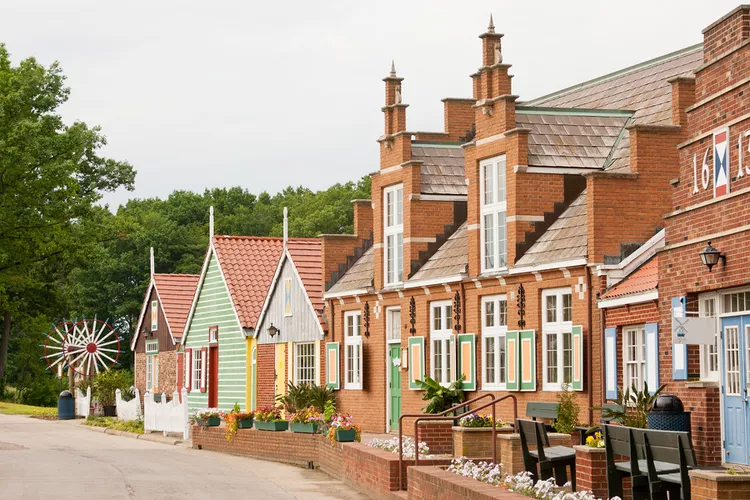
12. Holland, Michigan — The Netherlands in the Midwest
Feels like: The Netherlands | Best for: Tulips, windmills, Dutch heritage festivals
With its boundless fields of blooming tulips and towering windmills, Holland, Michigan is the spitting image of the Dutch countryside — and has been since Dutch immigrants founded it in the 1840s on the shores of Lake Michigan.
Holland’s annual Tulip Time Festival — held every May since 1929 — draws over 500,000 visitors to a city of 33,000, with 6 million tulips in bloom across 100 acres of public gardens. The De Zwaan windmill — the only authentic working Dutch windmill in the United States — was built in the Netherlands in 1761 and transported to Holland, Michigan in 1964. The Dutch Village theme park recreates a 19th-century Netherlands village with canals, traditional costumes, and Dutch cheese-making demonstrations.
Most European moment: Cycling through Holland’s tulip fields in early May, the De Zwaan windmill turning against a blue sky, Lake Michigan glinting in the distance — it is the Netherlands on a clear day, translated to the Midwest.
Don’t miss: Tulip Time Festival (first or second week of May), Windmill Island Gardens (home of De Zwaan), Holland State Park beach, and the Dutch Village theme park
Feels most like: The Dutch bulb fields south of Amsterdam — specifically the Keukenhof region
13. Napa Valley, California — Tuscany on the West Coast
Feels like: Tuscany, Italy | Best for: Wine, cycling, vineyard dining, spa culture
Home to more than 400 wineries, Napa Valley’s villa-style vineyards and wineries may have you wondering if you’ve somehow been transported to the heart of Tuscany. Combining elements of Italy’s rustic old-world feel with new world vines, the valley’s rolling golden hills, cypress-lined roads, and stone winery buildings deliberately evoke the Chianti region.
The parallels with Tuscany go beyond the visual: Napa has developed a destination food culture to match its wines, with Michelin-starred restaurants (The French Laundry in Yountville has held three Michelin stars since 2007), farm-to-table philosophy, truffle hunting, artisan cheesemaking, and olive oil production — the complete Italian rural luxury lifestyle, delivered with California efficiency.
Cycling between vineyards on quiet valley roads, stopping at tasting rooms for barrel samples, and finishing with a long lunch on a terrace is an experience that matches anything the Chianti Classico region can offer.
Most European moment: A long, unhurried vineyard lunch on a terrace at Auberge du Soleil above Rutherford, the golden valley stretching below in late afternoon light — Tuscany could not compete with this view.
Don’t miss: The French Laundry (if you can get a reservation — book 2 months ahead), Castello di Amorosa (an authentic medieval Tuscan castle winery), cycling the Silverado Trail, Yountville’s restaurant district, and the Copia museum
Feels most like: Tuscany — specifically the Chianti Classico wine region between Florence and Siena
14. Philadelphia, Pennsylvania — Colonial Europe on the East Coast
Feels like: London + Athens + Rome | Best for: History, architecture, food, walkability
Philadelphia is one of the most architecturally diverse European-feeling cities in America — a living catalogue of European architectural styles layered over centuries of history. Take a stroll down Elfreth’s Alley — the oldest continuously inhabited residential street in the United States, occupied since 1702 — and feel like you’ve been transported to 18th-century London.
But Philadelphia’s European qualities span multiple traditions: the Philadelphia Museum of Art looks like a Greek temple on the banks of the Schuylkill River. City Hall is a masterpiece of French Second Empire architecture, modelled on the Paris Opéra. The Italian Market in South Philly is as authentic as anything in Naples. Rittenhouse Square is a London square in everything but name. And Reading Terminal Market — housed in a Victorian train shed — rivals the covered markets of any European city.
Most European moment: Walking Elfreth’s Alley in the early morning — 32 perfectly preserved colonial brick townhouses on a lane barely wide enough for two people, the oldest in America — it is a scene from 18th-century London, unchanged.
Don’t miss: Elfreth’s Alley, Reading Terminal Market, the Italian Market (9th Street), Rittenhouse Square neighbourhood, Eastern State Penitentiary (one of the most impressive Gothic structures in America), and the Barnes Foundation (housing the world’s greatest private art collection)
Feels most like: London (Elfreth’s Alley, colonial architecture) + Paris (City Hall, French Second Empire buildings) + Naples (the Italian Market)
15. Tarpon Springs, Florida — A Greek Island on the Gulf
Feels like: Greece | Best for: Greek food, culture, sponge diving heritage
Home to the highest percentage of Greek Americans in the United States, Tarpon Springs boasts blue-and-white painted buildings, Greek street names, a local harbour filled with traditional sponge-diving boats, and a community that has maintained its Hellenic identity so fiercely that the town feels more like a Greek island than an American suburb.
Greek sponge divers arrived in Tarpon Springs in the early 1900s and built a community so culturally complete that Greek remains spoken in daily life. The Spongeoramas museum documents the history of the sponge diving industry. The Epiphany celebration every January 6th — when young men dive into Spring Bayou to retrieve a cross blessed by an Orthodox bishop — draws 30,000+ spectators and is one of the most authentically Greek celebrations outside of Greece.
Most European moment: Dinner at Hellas Restaurant on Dodecanese Boulevard — octopus grilled over charcoal, a glass of retsina, the harbour visible through the open doors — it is a convincing version of the Greek islands without the long flight.
Don’t miss: Dodecanese Boulevard (the main Greek strip), the Spongeoramas Museum, St. Nicholas Greek Orthodox Cathedral, Hellas Restaurant and Bakery, and the January Epiphany celebration
Feels most like: The Greek islands — specifically the working fishing ports of the Dodecanese
16. Helen, Georgia — Bavaria in the Blue Ridge Mountains
Feels like: Bavaria, Germany | Best for: Oktoberfest, Christmas markets, mountain scenery
Helen looks more like a Bavarian fairy tale than a Southern town. Once a fading timber community, it reinvented itself in 1969 after locals enlisted artist John Kollock to redesign it as an Alpine village, complete with half-timbered facades and cobblestone streets. Today, German-style restaurants, biergartens, and gingerbread-trimmed shops line the Chattahoochee River.
Helen’s Oktoberfest is the longest-running in the United States — running continuously from September through early November — and the combination of Blue Ridge Mountain foliage, half-timbered architecture, and flowing German beer creates an atmosphere that is genuinely festive and genuinely European in spirit.
Most European moment: Helen at Christmas: snow on the half-timbered buildings, lights strung across the cobblestone streets, the sound of a brass band carrying across the river — the Bavarian illusion is at its most convincing.
Don’t miss: Oktoberfest (September–November), the Christmas season (December), tubing on the Chattahoochee River, Nacoochee Village, and the Charlemagne’s Kingdom nutcracker shop
Feels most like: Bavarian Alpine villages — specifically the Bavarian style of Mittenwald or small villages of the German countryside south of Munich
17. New Glarus, Wisconsin — America’s Little Switzerland
Feels like: Switzerland | Best for: Swiss food, alpine architecture, craft beer
Founded by Swiss immigrants in 1845, New Glarus lives up to its nickname “America’s Little Switzerland.” The village brims with alpine charm: chalet-style buildings with red geraniums in every window box, signs in both English and German, and a cultural identity so distinctly Swiss that the Swiss ambassador visits regularly.
The New Glarus Brewing Company — perched on a hilltop like a Bavarian biergarten and visible from half the village — produces beers in the Swiss and German tradition that have achieved cult status across Wisconsin. The Swiss Historical Village Museum traces the town’s roots across 20 reconstructed buildings. The Wilhelm Tell drama, performed annually since 1938, retells the legendary Swiss hero’s story in the original German-Swiss dialect.
Most European moment: A summer afternoon beer garden session at New Glarus Brewing Company — Swiss chalet architecture, rolling Wisconsin farmland visible in every direction, excellent craft beer in hand — it’s Switzerland on a budget.
Don’t miss: New Glarus Brewing Company (home of the legendary Spotted Cow — only available in Wisconsin), the Swiss Historical Village Museum, the Wilhelm Tell Festival (Labor Day weekend), and Puempel’s Olde Tavern (established 1893)
Feels most like: The Swiss countryside — specifically the Alpine villages of the Bernese Oberland
18. Natchitoches, Louisiana — France on the Red River
Feels like: Provincial France | Best for: French colonial heritage, Christmas, historic architecture
Founded in 1714 by French explorer Louis Juchereau de St. Denis, Natchitoches (pronounced “Nack-uh-tish”) became the oldest permanent European settlement of the Louisiana Purchase territory. Its French heritage is apparent year-round, from the 33-block Historic Landmark District — home to the Basilica of the Immaculate Conception — to its cobblestone streets, wrought-iron balconies, and brick-paved riverbanks.
Natchitoches Christmas Festival transforms the city into a magical wonderland each December — 300,000 lights strung along the Cane River, fireworks, and a 10-week celebration that draws visitors from across the South. The Fort St. Jean Baptiste State Historic Site (a replica of the original 1714 French settlement) offers guided tours focused on the early French colonial era.
Most European moment: Natchitoches at Christmas: 300,000 lights reflecting on the Cane River, the brick-paved Front Street lined with French colonial buildings — it is provincial France reimagined by the American South.
Don’t miss: Front Street Historic District, Fort St. Jean Baptiste State Historic Site, Basilica of the Immaculate Conception, the Christmas Festival of Lights (November–January), and Lasyone’s Meat Pie Restaurant
Feels most like: A French provincial town — specifically the preserved colonial towns of Alsace or Lorraine in northeast France
Bonus: Hermann, Missouri — Germany on the Missouri River
Feels like: Germany’s Rhine Valley | Best for: Wine, German heritage, river views
Set along the Missouri River, Hermann feels like a pocket of 19th-century Germany preserved in the heart of the Midwest. Founded by German immigrants in the 1830s who wanted to create a community where German culture and language could be maintained, Hermann’s cobblestone streets, timber-framed buildings, and biergartens all reflect its proud heritage.
Stone Hill Winery — the second largest winery in the US in the late 1800s — still operates from its original 1847 stone cellars and produces Riesling and Vignoles with a distinctly Old World character. The annual Maifest and Oktoberfest celebrations transform Hermann’s downtown into something remarkably close to a German festival.
Feels most like: A village in Germany’s Rhineland wine country — specifically the Mosel Valley region
Quick Comparison: Which European Country Does Each US City Resemble?
| American City | State | Feels Like | European Country | Why |
|---|---|---|---|---|
| New Orleans | Louisiana | Paris + Seville | France / Spain | French Quarter architecture, Creole culture, Mardi Gras, French food |
| St. Augustine | Florida | Málaga + Seville | Spain | Founded by Spanish 1565, Castillo de San Marcos, Spanish Colonial streets |
| Boston | Massachusetts | London + Dublin | UK / Ireland | Beacon Hill cobblestones, colonial architecture, pub culture |
| Savannah | Georgia | Paris + Brussels | France / Belgium | 22 European-planned squares, Georgian architecture, café culture |
| Charleston | S. Carolina | Bath + Lisbon | UK / Portugal | Georgian row houses, cobblestone waterfront, Rainbow Row pastels |
| Leavenworth | Washington | Bavarian Alps | Germany | All buildings mandated Bavarian Alpine style, Oktoberfest, Christmas markets |
| Solvang | California | Copenhagen suburbs | Denmark | Founded by Danish immigrants 1911, windmills, Danish bakeries |
| Washington D.C. | D.C. | Paris + London | France / UK | Designed by French architect L’Enfant; neoclassical monuments |
| Frankenmuth | Michigan | Rothenburg ob der Tauber | Germany | Founded as Bavarian colony 1845; half-timbered buildings; Glockenspiel |
| Santa Barbara | California | French Riviera + Málaga | France / Spain | Spanish Colonial Revival architecture, Mediterranean coast |
| Carmel-by-the-Sea | California | Cotswolds + Brittany | UK / France | Storybook stone cottages, foggy coastal village character |
| Holland | Michigan | Keukenhof region | Netherlands | Founded by Dutch 1840s; 6 million tulips; authentic Dutch windmill |
| Napa Valley | California | Chianti Classico | Italy | Rolling vineyards, villa wineries, Michelin restaurant culture |
| Philadelphia | Pennsylvania | London + Paris + Naples | UK / France / Italy | Elfreth’s Alley, French Second Empire City Hall, Italian Market |
| Tarpon Springs | Florida | Greek islands | Greece | Highest Greek-American density in US; sponge diving heritage |
| Helen | Georgia | Bavarian Alps | Germany | Redesigned as Bavarian village 1969; Oktoberfest; Christmas |
| New Glarus | Wisconsin | Bernese Oberland | Switzerland | Founded by Swiss 1845; Swiss chalet architecture; German spoken |
| Natchitoches | Louisiana | Alsace-Lorraine | France | Oldest Louisiana Purchase settlement 1714; French colonial 33-block district |
FAQ: People Also Ask About American Cities That Feel Like Europe
Which American city feels most like Europe?
New Orleans feels most like Europe of all American cities — its French Quarter combines genuine French and Spanish colonial architecture, a deeply Francophone culture, European street names, Creole cuisine with French roots, and unique social customs (including legal street drinking) that are far closer to continental European life than to typical American cities. Boston is a close second for its British colonial character and walkable neighbourhood culture.
What US city looks the most like Paris?
Savannah, Georgia looks most like Paris — its 22 public squares, shaded by live oaks and surrounded by 18th-century townhouses, were designed using the same urban planning philosophy as Haussmann’s Paris. Washington D.C. also strongly resembles Paris, having been literally designed by French architect Pierre Charles L’Enfant, with wide diagonal boulevards, formal gardens, and neoclassical monuments rivalling those of the French capital.
What American town looks like a German village?
Leavenworth, Washington is the most convincing German village in America — every building in its downtown is required by city ordinance to conform to Bavarian Alpine architecture, and the town hosts one of America’s best Oktoberfest celebrations and Christmas markets. Frankenmuth, Michigan (founded as a Bavarian colony in 1845) and Helen, Georgia (redesigned as a Bavarian village in 1969) are close rivals.
Are there any American towns that look like Italy?
Yes. Napa Valley, California closely resembles Tuscany — rolling vineyard hills, villa-style wineries, and Michelin-starred restaurant culture that mirrors the Chianti Classico region. Carmel-by-the-Sea evokes the Italian Riviera. Philadelphia’s North End Italian Market rivals Naples. Tarpon Springs, Florida resembles the Greek islands rather than mainland Italy, but its Mediterranean character is unmistakable.
What city in the US is most like London?
Boston, Massachusetts is the American city that most resembles London — particularly the Beacon Hill neighbourhood, with its cobblestone streets, brick Georgian townhouses, gas lamp posts, and wrought-iron details that are indistinguishable from Chelsea or Bloomsbury. Washington D.C. also shares London’s neoclassical civic architecture and the formal park-and-boulevard urban planning of a European capital.
What part of America looks like Spain?
St. Augustine, Florida looks most like Spain — founded by the Spanish in 1565, the city retains genuine Spanish Colonial architecture including the Castillo de San Marcos fortress (built 1672–1695). Santa Barbara, California’s Spanish Colonial Revival downtown (white stucco, red-tiled roofs) resembles Andalucían coastal cities like Málaga or Marbella. New Orleans’ French Quarter also has strong Spanish architectural elements from the 1788 rebuilding under Spanish rule.
What is the most walkable American city that feels European?
Savannah, Georgia is the most walkable American city with a European feel — its 22 public squares and grid of historic streets create a pedestrian environment where a car is genuinely unnecessary for exploring the historic district. New Orleans’ French Quarter, Boston’s Beacon Hill, Charleston’s historic district, and Philadelphia’s Old City are all comparably walkable and European in their neighbourhood-scale urban fabric.
Is there anywhere in America that feels like the Greek islands?
Tarpon Springs, Florida is the closest American equivalent to the Greek islands — home to the highest percentage of Greek Americans in the US, with blue-and-white painted buildings, traditional sponge-diving boats in the harbour, authentic Greek restaurants, a Greek Orthodox Cathedral, and annual Epiphany celebrations that replicate the island traditions of the Dodecanese. Newport, Rhode Island has a different but equally Mediterranean coastal character in summer.
What American cities feel like France?
New Orleans (French Quarter, Creole culture, French cuisine), Savannah (Parisian urban planning), Washington D.C. (designed by French architect L’Enfant), and Natchitoches, Louisiana (founded by French explorer in 1714, 33-block French colonial district) all feel significantly French. For wine country specifically, Napa Valley and the Santa Ynez Valley around Solvang evoke French wine regions like Burgundy and Provence.
Are there American cities with Dutch or Scandinavian character?
Holland, Michigan is the most Dutch-feeling American city — founded by Dutch immigrants in the 1840s, it hosts 6 million tulips annually at Tulip Time Festival (May) and is home to De Zwaan, the only authentic working Dutch windmill in the US. Solvang, California is the most Danish American town, founded in 1911 by Danish immigrants complete with windmills, aebleskiver bakeries, and a replica of Copenhagen’s Little Mermaid. Poulsbo, Washington (“Little Norway on the Fjord”) serves as the Pacific Northwest’s Scandinavian enclave.
Final Summary: 18 American Cities That Feel Like Europe
| Rank | City | State | Best European Country Comparison |
|---|---|---|---|
| 1 | New Orleans | Louisiana | France + Spain |
| 2 | St. Augustine | Florida | Spain |
| 3 | Boston | Massachusetts | UK + Ireland |
| 4 | Savannah | Georgia | France |
| 5 | Charleston | South Carolina | UK + Portugal |
| 6 | Leavenworth | Washington | Germany (Bavaria) |
| 7 | Solvang | California | Denmark |
| 8 | Washington D.C. | D.C. | France + UK |
| 9 | Frankenmuth | Michigan | Germany (Bavaria) |
| 10 | Santa Barbara | California | France + Spain |
| 11 | Carmel-by-the-Sea | California | UK + France |
| 12 | Holland | Michigan | Netherlands |
| 13 | Napa Valley | California | Italy (Tuscany) |
| 14 | Philadelphia | Pennsylvania | UK + France + Italy |
| 15 | Tarpon Springs | Florida | Greece |
| 16 | Helen | Georgia | Germany (Bavaria) |
| 17 | New Glarus | Wisconsin | Switzerland |
| 18 | Natchitoches | Louisiana | France |
Last Updated: Information sourced from AFAR Magazine (December), Mental Floss (November), Smithsonian Magazine, Daily Passport, Backroads Travel Blog, and firsthand travel accounts. All cities remain active travel destinations — opening times for specific attractions should be verified locally before visiting.
